
vulnerable
on belly scratches and being human

The chartreuse suit. The red lipstick. They follow an entire movie of turquoise sofas, the most beautifully decorated hospital I’ve ever seen, pink snow, and stunning lacquered moss green kitchen cabinets rimmed in orange.
But when Tilda Swinton paints her lips toward the end of The Room Next Door, it’s not just one more technicolor image created with high-end interior design and boutique clothing. It’s a Fuck You to cancer. A wink to death. And most certainly a vivacious insistence on living and dying on her terms.
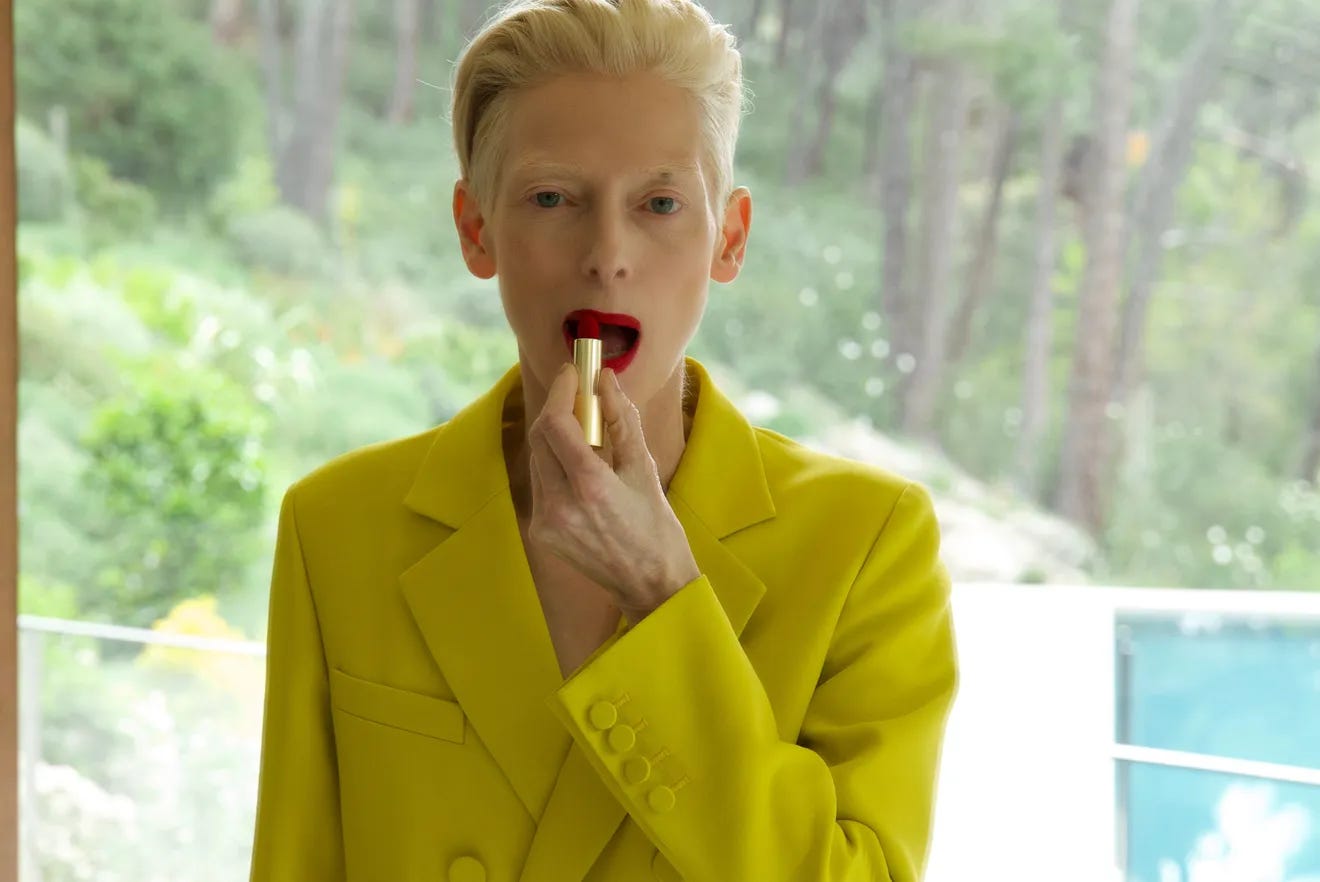
The scene has been a pebble bumping around in my shoe for the last few days. Initially, I was captivated by the color of the scene (the film’s lush visuals out-starred its weak dialogue, which is often clumsy; it’s Almodovar’s first English film). Spending a lot of time in medical settings, I think of illness as a place of muted tones. It can be hard to even recall the color of furniture, walls, or drapes in hospitals because they tend toward a monochromatic no-color.
Swinton’s act was defiant — dressing up for her planned death. The film makes a case for us to die on our own terms. If this means to die in a way that adheres to one’s values then, yes, I agree. As with birth, however, we can try like mad to get the details just right — the playlist, the people in the room, the hot tub, access to natural light — but often Life has its way of throwing curveballs.
A “good” death, like a good birth insists on vulnerability. It coaxes us and then, if we don’t oblige, pushes us to “Let go!” When we’re vulnerable, our outer shell of that thing called Self crumbles a bit; we move from material to intangible.
“Vulnerable” comes from the Latin vulnus, “wound.” It means to be capable of being physically or emotionally wounded.
And many of us avoid it like hell.
***
When Sarah was dying — which is what she was doing for nearly five years — she was so vulnerable. Not fragile. Or delicate. Not pathetic. Certainly not helpless. But it was like her bare belly was exposed most of the time, so available for a gut punch. There were tubes and patches and sometimes foul smells, weight loss, and no hair and then poofs of it and then no hair again. How could she be anything but vulnerable?
She had nothing left to lose and everything to lose. It was all precious to her. The groundhog under the back porch, the memory of crisp white wine on a hot day in Provence, the sensation of her feet being rubbed. All of it: amazing.
***
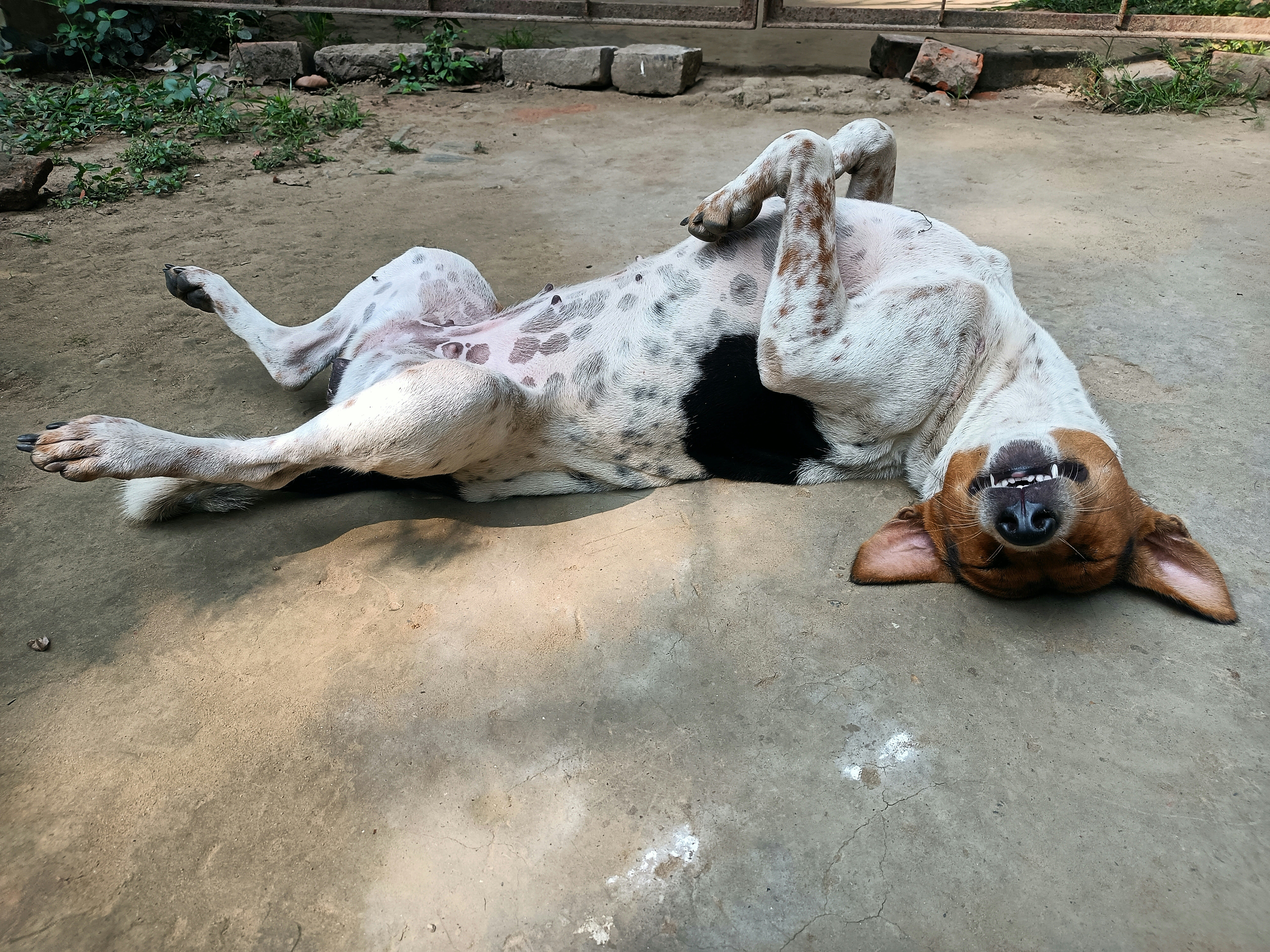
Animals show their bellies when they feel safe and relaxed. This tender place, with its access to the major organs and less protection from bones and large muscles, is where we mammals are most open to attack.
I wonder about the underbellies of non-animal entities. Not the Achilles heel, that weak point in a seemingly impenetrable person or entity where it can be taken down, but a soft spot that craves love and longs to be truly seen.
What is the underbelly of the United States? Of major corporations hellbent on profit over anyone’s well-being? Does cancer have a tender spot?
Western culture has tended to view vulnerability, especially in men, as something to avoid. Or maybe you have it, but by god do not show it! In socio-political work, vulnerability is rooted in dependency arising from asymmetrical relationships. Avoid dependency. And in an unequal relationship, be sure you’re the one on top.
Instead of expressing one’s own vulnerability as a sign of humanness that makes one more accessible to all — a leveling of any power differentials — we have too long swum in messaging, from Machiavelli to Darth Vader, that warns against such expression. I think here of Trump ridiculing people he finds weak.


Of course, it’s this blind desire or need to hit people at their weak points that often undoes the powerful. This week, I saw the Palestinian-Israeli documentary No Other Land. Some of the hardest scenes for me to watch were those of the needless wreckage of places and things that make life just a bit more tolerable for the Palestinians — a school being bulldozed right in front of the children’s eyes, cement being poured into a well as an old woman repeatedly cries “Why?” and an older man yells that water is a human right.
Again and again, the Israelis locate any weak point or soft spot while trying to cover their own vulnerabilities behind reflective sunglasses and body armor. That covering up, the inability to recognize and publicly own one’s soft spots, can in fact lead to demise — though it can take a long time to get there. Several times, one of the Palestinians in the film says that they (the Israeli army and the country’s leaders) will ultimately fail because of their inhumane tactics, though he says this in a tired voice that sounds like he’s trying to convince himself.
My friend who lives in Malibu described returning to the beach where nearly every house except hers burned down in January. “There was the road (aka Highway 1), and then there was the ocean,” she says. “There was really no ground for a house; I knew this but it didn’t really make sense until I saw the burnt remains.” With her hands, she shows the narrow distance between water and land.
The houses were built on posts, and the posts were covered in creosote to protect them from seawater. It turns out, these were the houses’ vulnerable points — not the water or the mudslides. “Most people didn’t even know their house was on fire because it was coming from underneath.”


***
“So, are you seeing anyone?” I’m sitting on a lurid orange plaid sofa in the basement of a local theater. A dear friend is in town to give a talk and we’re catching up quickly. Too quickly.
I roll my eyes and sigh. “I’m looking for jobs. I can only be so vulnerable all at once.”
To be in active, conscious dying is to be in a belly-exposed position on a regular basis. Whether being poked and prodded with drugs or tests, watching friends and family take care of you. The other option is to be in turtle position, so guarded that no one can get to your belly.
But we are vulnerable so much of the time if we admit to it. When we’re unemployed and unsure of where the next paycheck is coming from. When longing to be longed for by another.
Part of what Covid did was to bring our fear of death and illness, our need for community, our dependency on supply chains to the surface. Many of us had to drop our turtle shells. When we were able to see a dear friend, whether on a video screen or at a safe distance, we showed our bellies right away. “Here is my soft body missing and loving your soft body!”
To be fully human and alive to the possibilities of this world, means following Mary Oliver’s most famous of her many famous words: “You only have to let the soft animal of your body love what it loves. Tell me about despair, yours, and I will tell you mine.”
Loving / Listening / Reading
This list of small ways to resist the “authoritarian harm regime” is worthy of printing out and taping to your fridge. Here are a few that I particularly like:
Write down one lie you’ve stopped believing. Honor that shift.
Delete one productivity hack that makes you feel like a machine.
Resist the pressure to summarize. Let complexity stand without apology.
I am a longtime fan of Maya Stein. She and her wife Amy came through Iowa City years ago on a tandem bike that was trailing two manual typewriters. They set up shop for an afternoon here in Iowa City and wrote poems for people. She edited a book called Grief Becomes You and was kind enough to include a divorce poem of mine that was filled with poker-hot fury. This week she offered one of her 10-line poems called “magnolia” that includes these lines: “Cinematically, the clouds part, the dashboard readout
says 68 degrees, and I’m floating in the sudden amniotic spring…” Go check her out: Maya Stein
I hope your spring has moments of floating. Of perfumed petals. Of asparagus and the first garden greens. I hope your spring has very few ticks and less loud headlines. I hope your spring is soft and vulnerable, and that someone is there to scratch your underbelly.
Thank you. I had not heard of either movie, and I'm going to look up the poet you mentioned who's name escapes me as I write this. Vulnerability is one of my favorite things about being human and I appreciate your words on it. Thank you.