
Tendrils
I imagine tendrils sneaking through fence lines, under oceans, between hearts, tunneling borders. Tendrils winding across time zones and through geologic eras.

I was at the bank depositing a check—something I can do via an app, I know, but I like going into the bank. It’s empty these days, a monument to a former time. The tellers are all young and seem eager for anything to do. “What’s Hypha?” the teller asks, stamping the back of the check made out to my business that bears that name. He spoke with a slight African accent, and was wearing a floral shirt in various blues that I admired.
I explained how hyphae are the tendrils that connect fungi to each other and to all living things across forests, throughout the ocean, and within your body. Hyphae are the fungal network that we collectively call mycelium. They are everywhere, unobtrusively connecting us.
“Like that movie, Fungi!” the teller exclaims, suddenly very alert, the bored look gone. He gestured to the teller next to him and asked if he knew about fungi – the vegetative state or the movie, I wasn’t sure which. When the guy frowned a no, blue shirt teller went into an excited description of how amazing fungi are and ended by saying: “You are fungi. We are all fungi.”
And with that, my transaction was done. It was more than ample receipt for taking extra time—again, I could have put the invisible money in my invisible account via the algorithms of an invisible app—to go to the bank and meet the teller. I left wondering about him: Where in town does he live? Has he always lived here, and if not, where else has he lived? Does he study at the university? Why does he work at the bank? What led him to watch the documentary?
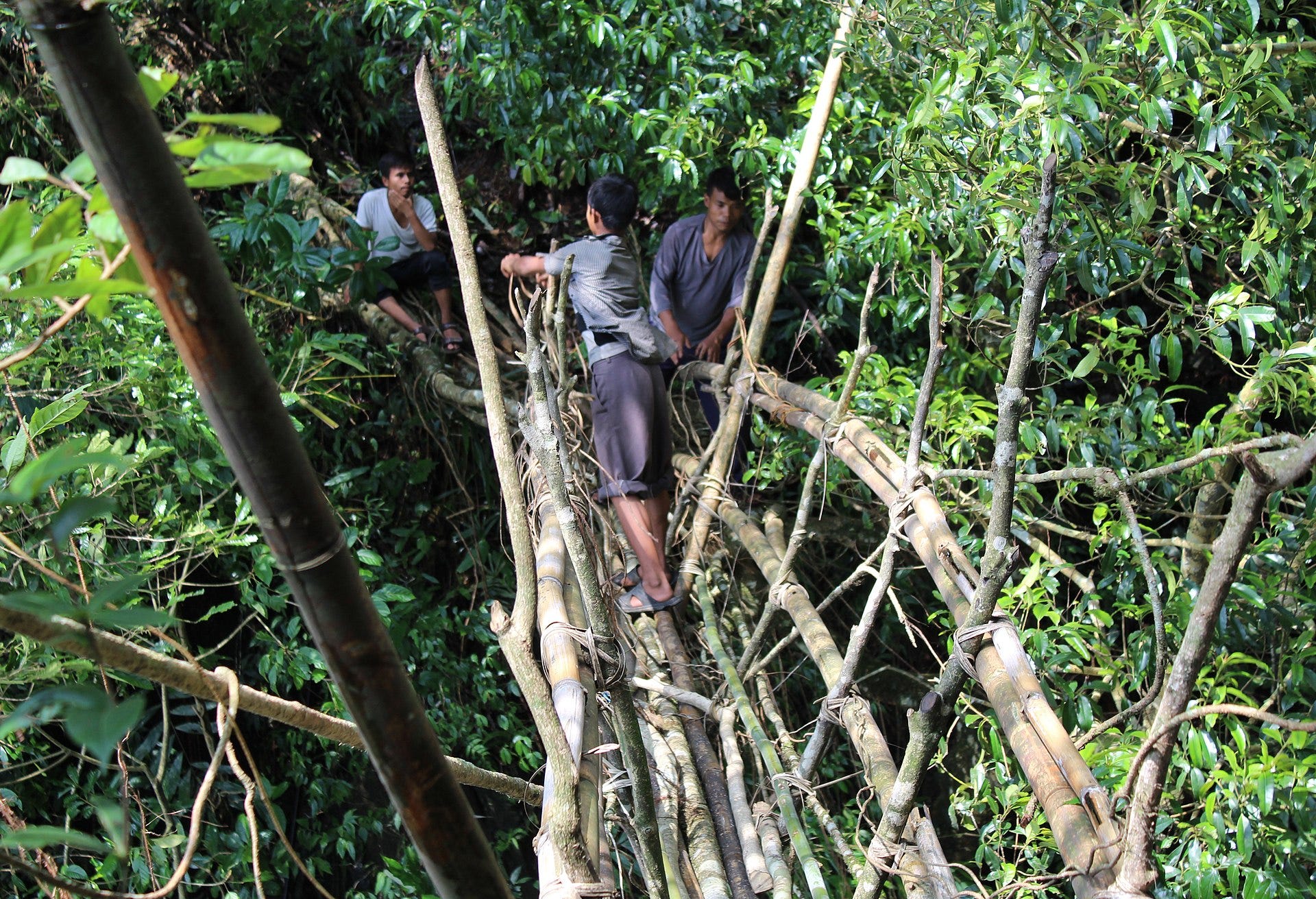
Fast forward a week, and my meditation group was reading aloud from a section in a book about belonging. The author mentioned people in far northeastern India who’ve created bridges out of living roots to cross a river that becomes impassable during monsoon season. People coax the roots to grow over the water and then braid and shape them into walkways for safe passage. We marveled at the time—generations, the author said—it takes to do this, the commitment to the plant as well as to the community.
The next day, the woman I was meeting with over a work coffee paused to ask after my kids. Our children all grew up in Iowa City; in fact, she was my kids’ preschool teacher for a moment back in the early aughts. As we do, I asked about hers, and she told me about her younger son’s life in Madrid, and how he’s soon going on a solo trip somewhere in India. She’s concerned because he has health issues and he’ll be very far from any medical care or family. To make the point of just how distant this place is, she said, “They make root bridges over the water!”
How odd. Could it be? I asked if it was Meghalaya. Yes!
She was excited that I knew this word, that there was this connectivity between the woman sitting in front of her and the place where her son would soon be going. It made it more real. Perhaps even safer. She was as excited as the teller has been about hyphae.
How many tendrils connect us in ways we can’t fathom? I think about this often. I imagine these tendrils sneaking through fence lines, under oceans, between hearts, tunneling borders. Tendrils winding across time zones and through geologic eras. They’re there, all the time …
A friend went to Seattle this week to prepare to donate his kidney to an old acquaintance whose plea for an organ reached him on social media. They were the same blood type, a match. And now he’s across the country, being tested for absolute confirmation before surgery.
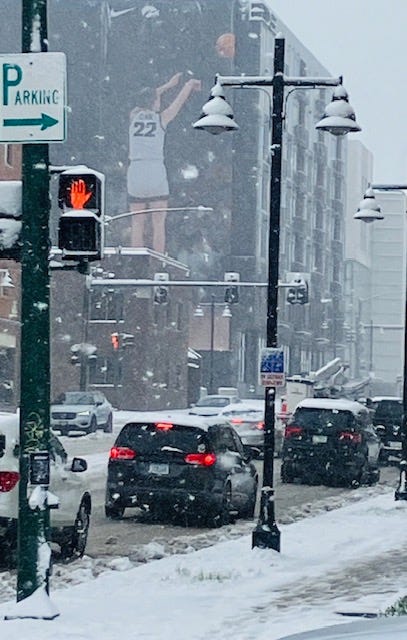
I turn on the car radio and hear my favorite news podcast—the place where I get reliable information about wars and elections and housing affordability. But not today; today, they are talking about Caitlin Clark. The Iowa basketball star is known here, but suddenly she’s known everywhere. She’s BIG. In fact, at the very moment that I heard the podcast, I gazed up through thick March snowflakes at an immense banner of Clark, who seems to be shooting right into our midst.
Last week I was invited to a friend’s house. It was a balmy evening (yes, it’s Iowa – we do balmy and snow back-to-back this time of year), and he had people over for an early spring cocktail party. I couldn’t make it, but he told me later they’d been interrupted by sirens and a gaggle of ER vehicles outside a neighbor’s house. It turned out to be the unexpected death of someone central to the local music scene. In the days since, my screens have been filled with words of gratitude, sorrow, and disbelief about this person passing. He was a river from which many tributaries flowed; even without knowing him, I feel the loss of this node.
We are each a system. We live within each other, through each other, because of each other. A basketball player in Iowa inspires a girl in Paris to start dribbling. An event producer entices a band to a smallish town off the interstate and their performance lights a whole new path for a writer’s project. A young man recalls his excitement for a documentary and enrolls in a class. A man waits for a kidney and it arrives, culled from another body. A mother worries less.
Go into the bank next time you’re about to use that app. Ask questions of everyone and anyone. Reply to the stranger, even if it’s awkward. Listen to the music that’s weird. Get curious. Each tendril holds worlds.

Current Work: Finding the narrative through line
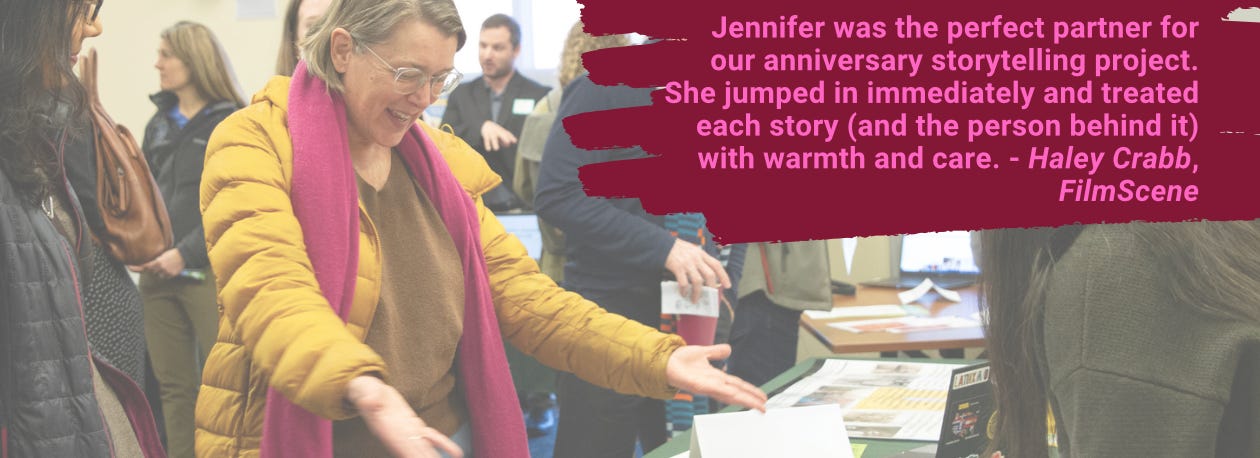
How do three teams of scholars, each coming from significantly different disciplines and academic approaches, find a through line that allows them to collaborate? This was the leading question of a series of four workshops I facilitated for a dozen researchers whose training spans from engineering to anthropology.
We spent our first session sharing stories and recalling what makes for an effective narrative. Our middle sessions focused on ethics, working with partners, and crossing campus/community boundaries. Playing with clay, we modeled our respective projects, and then sought points of connection between our work.
This was an initial run on a series that we hope to extend to other groups, building a robust interdisciplinary network of scholars collaborating on Midwest-based, publicly engaged work.

Inspiring me these days …


I am just a month into working with Roshi Joan Halifax and Upaya as part of a two-year in-depth dive into systems, inner resources, the heart of service, and living by vow. The first reading on a long and complex list is Standing at the Edge. It’s my second time through this book, which is filled with so many useful reminders of how to live in The Crazy, from dysfunctional workplaces to the suffering of the world’s war zones.
Did you know women weren’t initially considered able to get AIDS? As a result, they couldn’t be diagnosed and access insurance coverage for medications, in-home caretaking, and other benefits. Katrina Haslip was incarcerated and living with AIDS when she began organizing against this false construct. I haven’t been able to get Katrina out of mind and heart after hearing her story on the 6-episode podcast, Blindspot, about people affected by the early days of the AIDS crises who fall outside our usual story.
The upcoming annual zine fair at PS1, Ice Cream, is kicking my butt right now! In the best way, it’s helping me finish up the second JOY the Zine. I’ll be there on April 6 with the new issue, along with my amazing daughter Bella who will have her feminist healthcare zines. Find us if you’re roaming around Mission Creek.

Read Ross Gay in Community - We’ll have fun!
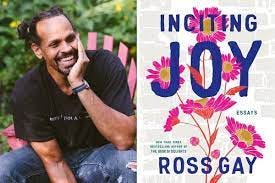
The Community for Joyful Resistance will gather April 13 and 23 to dive into Ross Gay’s essays Inciting Joy. Register for this community book group that’s on Zoom, and we’ll chew together on these delightful examples of joyful resistance. Our last group had participants from across the country and we ranged across several generations.
Final Randomness …
I have oatmeal for breakfast a few times a week, and every time when I sprinkle cinnamon into the bowl, I have a moment of high anxiety that I accidentally grabbed cumin. I could move the cumin, but this would disrupt the alpha order. And so I fret.
My hands have reached a level of dryness that I hoped to keep at pay until my 70s. It’s arrived too soon.
I thought I’d found the perfect sourdough recipe. Loaf after golden loaf was sour, chewy, with good hole structure. Not perfect, but more than good enough. And now - failure after failure! I have no idea why - so frustrating! The last loaf I didn’t even let bake all the way through - just tossed it. Frick and frack!
It’s my grandma’s birthday. I miss her.
I love this! Took me back to Iowa City where we left in September for a new adventure. Watched Caitlin on tv instead of inside the stadium. Love the tendrils connecting us.
As is usual with your pieces, Jennifer, this one profoundly resonated with me. As I've been processing the death of my son Jesse, stories keep filtering in from folks I know, folks I don't know, about the positive effect he had on their lives. Those stories have been both a comfort and an inspiration. Keep reaching out. Seek out those tendrils, or hyphae, that connect us.