
spellbound
on balancing logic with mystery and magic

I have bad luck. It’s like I’m under a dark cloud.
I say this to my therapist and totally believe it, while also hearing the holes in this stringy theory.
It’s like there’s a curse on me.
“Let’s go with this,” she says with a hint of amusement in her voice—as though to say, I don’t buy it, but let’s see where this leads. “How do you break a curse?”
This is the question I’ve been sitting with this for the last few days, and here’s what I’ve come up with:
Throw down a counter curse. (Cue Hermione Granger, Queen of the Counter Curse, perhaps the greatest embodiment of magic-meets-logic.)
Kill the one responsible for the curse. (Perhaps the route Luigi Mangione imagined he was taking.)
Dab on a potion, smudge with smoke, wear a charm. (All of which can be culturally appropriated in complicated ways so take heed.)
Go the route of logic: prove that ‘the curse’ is a false mental block.


Logic is good, necessary, and needs to be protected. At this moment in history when fact and science are being questioned by so many, I don’t want to suggest that logic is an unworthy approach. Logic and the science built from it are crucial ways of understanding Self and World.
And: it’s not enough. Science, no matter how true, needs art, mystery, and heart space to carry its message.
"The good thing about science is that it's true, whether or not you believe in it.” – Neil deGrasse Tyson
This fall I facilitated a series of workshops for academic researchers whose work spans from language as a political tool to mental health and food systems. All of them are well versed in their disciplines’ traditional modes of research that occur in archives, labs, and “the field.” They know how to collect data and parse evidence. But as one political science said in our closing session yesterday (to paraphrase), “I’m bored with data. I want to hear stories.”
What I took her to mean is that she wants to hear people’s lived experience. What I didn’t take her to mean is that she wants to embrace the kind of fantastical tales pulled from the ether to back up what people in power want or need others to believe—the kinds of stories that have propelled the incoming administration and too many other political leaders around the world.
Stories and other heart practices help us make sense of the angular and often hierarchical information that we’ve bowed down to for too long as The Way, The Answer. Data can lead us in the direction of responses to issues like climate change, but it will not move the needle alone. Our hearts are too loud, too busy, too insistent to be fed with color and beauty.
We need the magical arts—painting, dance, music, poetry—to help us engage with the state of our world. While climate, gun violence, racism, and other mass harms can be measured, such numbers are often too boggling to comprehend, or so bleak as to lead to numbness.
..nor can we know ahead of the fact the unending absence that follows, the void, the very opposite of meaning, the relentless succession of moments during which we will confront the experience of meaningless itself. – Joan Didion, The Year of Magical Thinking
I had a beautiful conversation this week with artist-geographer Valentine Cadieux who works at the juncture of heart and science. After witnessing a concentration of high-water usage dairy farms in the southwest and wondering about their effects, she deepened her knowledge of the Ogallala Aquifer.
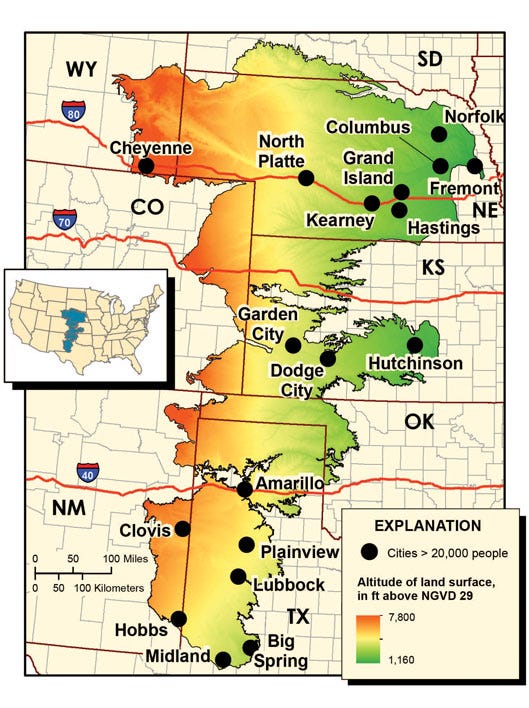
Running through eight states, it has been being drawn upon for agricultural irrigation since the 1950s. With ever more aggressive techniques for tapping the water at deeper levels and with an ever greater demand from large-scale agriculture, the aquifer is in danger. Once depleted, it will take over 6,000 years to replenish naturally through rainfall.
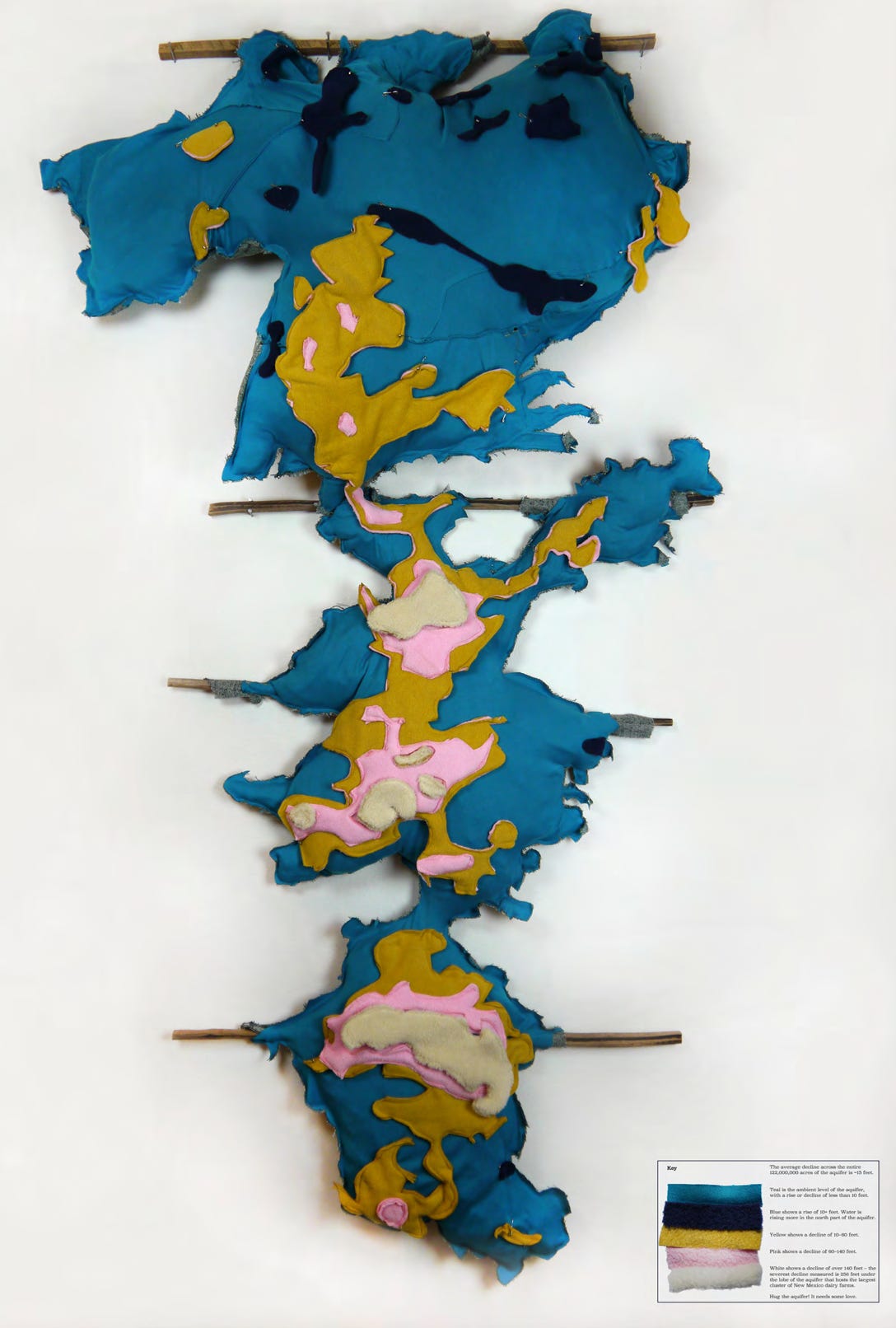
Cadieux created a foam and fabric model of the watershed titled Hug the Ogallala. While some scientists might find the artwork and its title twee, I’d argue that it provides an embodied understanding of the aquifer that government-produced maps cannnot. It invites us to embrace this body of water, to stand one living body to another. The map, on the other hand, supposes water is a resource for humans. It works from a vantage point of loss—that losing water is dangerous for humans. What this loss means to the water is not the map’s story.
I think of people trying to do work in the areas of social change who get hung up on numbers—sometimes by their own choosing but often because the power structure demands quantitative evidence and nearly always preferences it. (In running my business, I’ve been told many times that I need to quantify the effects of what I provide; show them the money. But what I offer — seeing issues from a new vantage point, deepening personal connections resist quantification) If we focus almost entirely on how many people were affected by a policy or program, we may completely lose site of the quality of that affect.

The huggable watershed doesn’t suggest any specific magical response to the curse of the dwindling waters, but it reminds us that our whole beings are needed now. We can’t think ourselves out of the bramble we’re in; we must touch the places where our world is damaged. Hold them with our arms. Bring our imaginations, fueled by story and beauty and metaphor, to the wounds
In end of life work, there is often tension between those seeking to prolong life and those in favor of honoring the quality of one’s days. Medical professionals are steeped in the former. It’s a sort of parallel mindset to the development and growth that underpins so much of Western society; a “don’t stop at any cost” approach that values bigger numbers, whether those are the bottom line on a spreadsheet or the days spent living.
For ages, however, end of life was a time of mystery. There were practices to help the person and their community bridge worlds. Magic was as welcome as any medicinal response. And this served to help us let go, loosen our grip, and fall back into something that might be called faith.
I’m seeking magic these days - building my intuition, choosing quality over quantity, depth over breadth. As anthropologist-philosopher Loren Eisley, who was born in Nebraska at the heart of the Ogallala Aquifer, wrote: "If there is magic on this planet, it is contained in water.” Let our time be spent looking for such magic, embracing it, and protecting it—not for ourselves but for the waters (and air and soil) themselves.

Listening + Reading + Looking


Speaking of magic …
I loved this conversation on The Daily about the rebuilding of Notre Dame. This amazing feat included scouring France to find the right tree for the right beam in the ceiling. Like not just any tree — but a specifically shaped tree for a specific part of the ceiling. The five-year project, which many said was an impossible timeline, brought together a large team of crafts people who credit it as the experience of a lifetime — a reminder that we all want to belong and be of use.
Indy Johar—an architect and co-founder of Dark Matter, a field laboratory focused on building the institutional infrastructures for radical civic societies, cities, regions and towns—talked on the Great Simplification podcast about the need to embrace ways of thinking beyond what Western society has celebrated “…we've rooted ourselves in a theory of humans as individual and as object hoods; I think one of the key journeys that we're in the middle of is to re imagine ourselves as not just beings but becomings.”
Caitlin Clark is magic. Proven again this week. I happened to be awake at 2:30 am the other night when the TIME Athlete of the Year cover dropped. Tingles!
And Terry Tempest Williams’ book of essays, Erosion, focused on assaults on public lands in the West, presents evidence through lush, sensory-filled language. Echoing Johar, she wonders if “our undoing is also our becoming.” And she offer us this hard gem: “Rather than anchoring our hope beyond the struggle, always projecting ahead, perhaps locating joy within the struggle through our full presence can be our essential gesture at this moment in time. To feel the pain of now and not look away.”

Work with me … Writing Coaching, Facilitation, and Communications
I’m filling my dance card for the winter and early spring and would love to talk with you about ideas, needs, and dreams. Helping bring people together to build community is one of my greatest pleasures — second only to my love of accompanying people on their writing journeys. If you have an organization in need of course correction or help tackling a new challenge, OR if you’d benefit from support on a book writing journey, reach out!

How to Break a Curse
By Danielle Boodoo-Fortuné
Lemon balm is for forgiveness.
Pull up from the root, steep
in boiling water. Add locusts’ wings,
salt, the dried bones of hummingbirds.
Drink when you feel ready.
Drink even if you do not.
Pepper seeds are for courage.
Sprinkle them on your tongue.
Sprinkle in the doorway and along
the windowsill. Mix pepper and water
to a thick paste. Spackle the cracks
in the concrete, anoint the part
in your hair. You need as much
courage as you can get.
Water is for healing.
Leave a jar open beneath the full moon.
Let it rest. Water your plants.
Wash your face. Drink.
The sharpened blade is for memory.
Metal lives long, never grows weary
of our comings and goings. Wrap this blade
in newspaper. Keep beneath your bed.
Be patient, daughter.
Be patient.

How to support my work
I offer these words freely and appreciate your donations via "Buy me a coffee.” Other modes of support are sharing this post with friends and telling colleauges/friends who need writing coaching or facilitation about my services.
And although all of the money goes to this cycle’s nonprofit recipient, Public School Strong, it makes me crazy happy when anyone buys a copy of JOY the Zine. It’s the perfect stocking stuffer for progressive pals!

