
lineage
On looking for lines in the days after my mother's death.

“Grief turns out to be a place none of us know until we reach it.” - Joan Didion
“If you remember your lineage, you will never feel lonely.” - Philip Glass
“To forget one’s ancestors is to be a brook without a source, a tree without a root.” - Chinese proverb
My mom’s attorney came to her room in the care facility the week before she passed to have her sign a document that named me as her lineage. He described it as the dot on an i — not entirely necessary but signing it would make her feel better. Much of my mom’s concerns in the last month have been practical — telling me passwords and the whereabouts of papers, cancelling dental appointments and reviewing artwork.
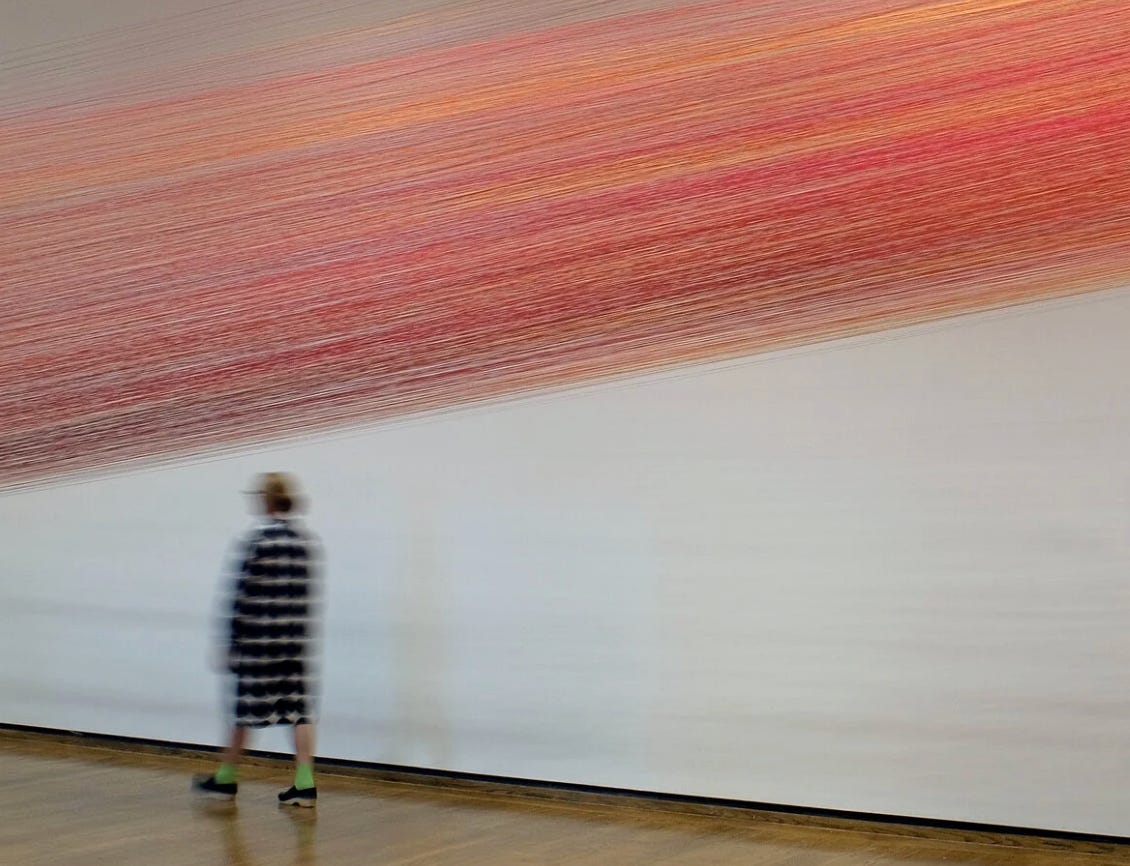
The lawyer — a really nice guy who is mainly retired except for a few of his longest running clients — was apologetic about this relatively unnecessary document. He said he tries to avoid the word “lineage” and just inserts the person’s name instead. But I rather like it. We are, after all, connected by lines thick and thin, invisible or on full view.
As part of preparation for taking jukai, the ceremony signifying commitment to living by the Buddhist precepts, I made three lineage charts. Two were on enormous sheets of mulberry paper, written in a combination of black for the names and red for the blood line. The first was the traditional chart that shows the unbroken lineage from the historic Buddha, Siddhartha Gautama, to one’s own teacher, with a space at the very bottom for one’s own name. Although it appears to be a line, if you look closely you see that it’s actually a closed loop without ending or beginning.


There are only two females named on my chart — Roshi Joan Halifax, who ordained me, and me. The second chart was created in recent decades to rectify this omission of the many women and two-spirit people who contributed to the dharma, dating back to the Buddha’s mother. Whereas the other is ladder like, this chart is circular.
The final lineage represents our teachers and the format was of our choosing. I made mine on paper from the previous year’s calendar. I wanted to reuse the paper and to have time folded into the chart, which is broken into four sections — earth, air, fire, and water. I included people, places, creatures, and elemental forces that have been teachers. The ebb and flow learned from waves. The rootedness of trees. There are human teachers in it — some who taught me discipline and passion, others who modeled calm and acceptance.
My parents are both on the chart, as is my paternal grandmother. I can tell you concretely some of the things grandma Phyllis taught me — how to identify the birds that lived in her woods (something I’m trying to relearn); how to differentiate between an oak, a maple, and a hickory tree; the basics of batik; how to age with curiosity and grace. My father taught me how to drive (stick shift on gravel roads, no less) and how to balance a checkbook. He reminded me to be aware of oil changes and insurance premiums. He taught me to iron shirts and prune shrubs. After he died, a friend wrote to tell me that he always recalled what my dad had taught him: put the ice into the glass before you pour in the soda.


There are things I remember my mom not teaching me — like when she handed me a box of tampons, opened the bathroom door, and then left to go make dinner. So much of what she tried to teach me, I resisted learning — or practicing — either because I didn’t agree with the lesson, or couldn’t afford it. She taught me, for instance, to invest in well-made clothing that would last for years and not go out of style. To always have a black dress for a funeral. She tried to instill the importance of not leaving the house unless your hair was brushed, there was a dab of blush on the cheeks and color on the lips, and you were wearing matching, unwrinkled clothes. And to never ever travel without cash.
None of these do I practice.
Here are things I did learn from my mom: I put my napkin on my lap at the outset of a meal — as do my kids, who knew that not to do so could lead to a short reprimand. I write thank you notes and sympathy cards because of her — she insisted on the former as soon as I could write, and I learned the latter through her example. I shop locally. I try to leave tips for hotel maids, though sometimes I have no cash because of the above.
When I worked at the university, I met many people who remembered my dad fondly. They were usually in prestigious positions higher up the food chain. They recalled his kindness and humor, as well as his style. (I spent a solid chunk of my childhood in men’s clothing stores.)
The people on campus who remembered my mom were more often in service positions — groundskeepers, catering, facility workers, and office admins. Every one of them smiled at her name. Many had funny stories to share, memories of sharing a smoke. They recalled her hallmark laugh — a loud chuckle you could hear at a party before she came into view. Many told me of how they’d received letters from her — cards of thanks for a job well done, a note when a spouse had died, congratulations on getting citizenship, a gift card at the holidays.
In the past five weeks of my mom’s transition from healthy to exhausted, from weighted under news of cancer but without clear prognosis, and, finally, to the clarity that this would be fast, I’ve felt the lines between us. The strings, supple and strong, that connect us. There is our mutual love of restaurants — hers born from her dad’s restaurant in Chicago, mine from going to fancy places with my parents on special trips into that city. Or our shared allegiance to spelling and grammar, to bookstores and libraries.
These lines go back to sturdy German women in Wisconsin drinking beer and playing cards. They are even now moving forward to whomever is living in Bella and Tobey, awaiting that umbilical connectivity.


We all come from somewhere. But we don’t do a very good job of remembering this, honoring it. We can’t wait to leave home. Light off for new territories instead of learning the calls of local birds, the texture of the tree bark in our own region.
I’m attracted to models that push back on this amnesia. In Buddhism, when someone gives a talk, they nearly always begin with thanks for their teachers, especially their “root teacher,” the one who has introduced them to that particular lineage. Or the lines that hold restaurants together — both the day-to-day roles that keep a kitchen going and the family-style learning that extends from one chef to another.
In the late 1800s, Escoffier created the brigade system, a military-like hierarchy that provides order out of chaos and, yes, sometimes too much “me over you” mentality. More endearingly, there is the generous acknowledgement by a chef of those under whose guidance she came up the line (literally). Often, the obituary of a chef will mention their best known students. And those with long lives, like Alice Waters, have so many progeny that there are maps of every restaurant in the Bay Area run by a Chez Panisse alum. The point is that chefs know from which they came — both their hands-on training and the cookbooks that inspired them. They can draw a line from their earliest days of truly curious eating and making, to their current cooking.


I began writing this piece a week ago today, sitting next to my mom on January 17, listening to her gurgling breath, not knowing where she or this would lead. But needing, as I always have, to write in order to find the lines of heart and mind. The next weeks and months will be filled with untangling the everyday bits of her life — bank accounts and bills. But for years, I’ll be trying to find and follow the lines she threw me — rules, norms, and examples by which to live.
When my daughter was leaving for college, I began to panic: Had I taught her enough? Had I taught her anything? I started writing little lessons, things I wanted to be sure she knew. The first was about how to boil an egg. I kid you not. I told her what I was doing and she gently laughed; “Mom, I know how to boil an egg.” I put the idea aside. I’d been casting lines for years. She’d watched. Like me with my mom, she could now choose which ones to follow. Some might appeal to her now, others later. But they were there. Ages of lines.
Small nibbles of reading for sanity
We Are the Sycamore Gap Tree - An essay about how the cutting down of an epic tree mirrors our Greenland-obsessed so-called president.
What Is Ours - An account of an octopus mother who stayed on her nest for years — not the usual months — and the author’s questioning about what we can tend.
A conversation with Terry Tempest Williams and Susan Murphy - “The truth of the lake’s absence can bring us into relationship with its presence.” Terry speaks of the relationship between her mother, lineage, and the Great Salt Lake.


Beautiful and wise, my friend. Hugs as you process all the changes.
I don't have the words or the thoughts to express how much I enjoyed reading this piece. Few people can write so beautifully and have the deep thoughtful insights to bring to bear on a subject like this.